
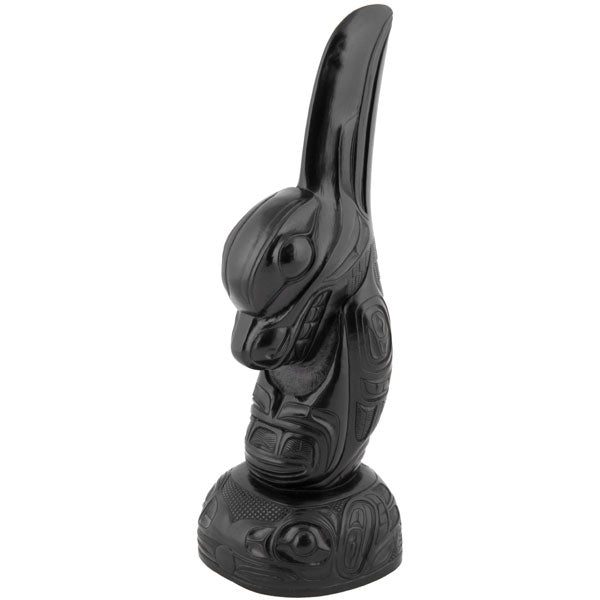
Raven Transformation to Killer Whale

$100.00
Item No. B115
This is a reproduction of an argillite piece in the Canadian Museum of History's Haida Gwaii collection. The original was carved by Ed Russ, who was born in 1953 in Masset. The height is 7 inches, color argillite black. This museum quality reproduction is made from a natural resin composite to attain the heft of the argillite original. Made in Canada.
This is a reproduction of an argillite piece in the Canadian Museum of History's Haida Gwaii collection. The original was carved by Ed Russ, who was born in 1953 in Masset. The height is 7 inches, color argillite black. This museum quality reproduction is made from a natural resin composite to attain the heft of the argillite original. Made in Canada.
-
The Haida carvings in argillite are some of the finest presentations of totemic art. These reproductions are well made from original work in Canada, made in a natural resin composite with the heft and finish of the originals. These museum quality reproductions of the older work are available in a range of styles that can be more casually displayed so that the art can be enjoyed on an everyday basis. The reproductions are made by Boma, a Canadian company producing a range of collectibles and giftware.
-
Totem poles are the outstanding monumental art of the Northwest Coast Indians. The classic era of the totem poles was the latter half of the 19th century, when both iron tools for carving and the wealth needed to erect a pole were made available from trade with the European traders. Totem poles both proclaimed and showed acceptance of the position in the community of the person for whom the pole was erected. The time and expense required were large. A suitable cedar tree had to be found and brought to the site. The crests and traditions to be displayed were selected. Small poles in yellow cedar or, among the Haida, argillite, might be carved as part of the design process. A carver was appointed who then was set to carving the pole. Labor and cost of all this work was born by the extended family of the "owner" of the pole, and might take several years to complete. Finally the pole was erected in the presence of large numbers of people from local and neighboring groups, in a major ceremonial gathering in which the position of the "owner" and his right to the crests and traditions was proclaimed and accepted and, as a necessary part of power and influence in the community, the wealth of his extended family was shown by the liberality of the feasting and goods given away. Wealth was not measured so much by what material goods one held, but more by what one gave away in public ceremonies. Erection of totem poles declined abruptly around the turn of the century, but has revived in a smaller way recently, mainly as government-supported "tourist" poles. In addition, as the suppression of Indians by church and state has been lessened, and the Indians have been allowed access to better education and economic opportunity, a few poles also are being erected within the community in the traditional spirit, inspired by, and indeed testifying to, the renewed self respect of the native peoples.
-
The most important of all creatures to the Northwest coast Indian peoples was the Raven. He took many forms to many peoples -- the Transformer, the cultural hero, the trickster, the Big Man. Full of magical powers, the Raven could transform himself into anything. He put the sun in the sky, the fish in the sea, the salmon into the rivers. His antics were often motivated by greed, and he loved to tease, to cheat, to woo, and to trick.
-
Whales, a common motif in the art of the Northwest Coast peoples, were the subject of countless stories and legends. One story held that a whale could capture a canoe and drag it and the people aboard down to an underwater Village of the Whales. These people were then transformed into whales themselves. The Haida believed that whales seen near villages were these drowned people trying to communicate with the villagers. A Tlingit legend tells that the first orcas (killer whales) were carved from yellow cedar and sent into the ocean with instructions to be friendly towards people. The killer whales guide the Indians towards fish and are helpful except when they are treated discourteously.
